

Russia presented its spring 2026 offensive as a campaign meant to deliver a breakthrough, new territorial gains, and eventually the fall of the so-called "Fortress Belt" in Donetsk Oblast, an area that has always held a special place in negotiations on a possible "peace deal".
Months of spring assaults brought only limited territorial advances at enormous cost to Russian personnel.
At the same time, Ukraine expanded its long-range strike campaign inside Russia
, increasing pressure far beyond the front line, and also regained battlefield initiative for the first time in months.
The plan was ambitious: overwhelm Ukrainian defences through constant pressure and attrition. A major target was the so-called "Fortress Belt" in Donetsk Oblast - one of the most fortified defensive lines in Ukraine, as capturing Sloviansk, Kramatorsk and Druzhkivka would give Moscow not only operational gains, but also a symbolic victory tied to the unfulfilled ambitions since 2014. In 2026, the Kremlin appeared determined to try once more: Russian forces sharply intensified assaults across the sector, while Ukrainian commanders reported hundreds of assault attempts over several days.
The offensive stalled because the war itself had changed.
The battlefield of 2026 no longer favours large armoured assaults: Ukrainian FPV drones, dense minefields and constant aerial reconnaissance turned every movement near the front into a risk. The change became evident even in the way Russian troops moved - on motorcycles and in small infantry groups rather than armoured columns. Instead of a breakthrough campaign, the offensive turned into a slow, costly fight for villages, roads and forest strips.
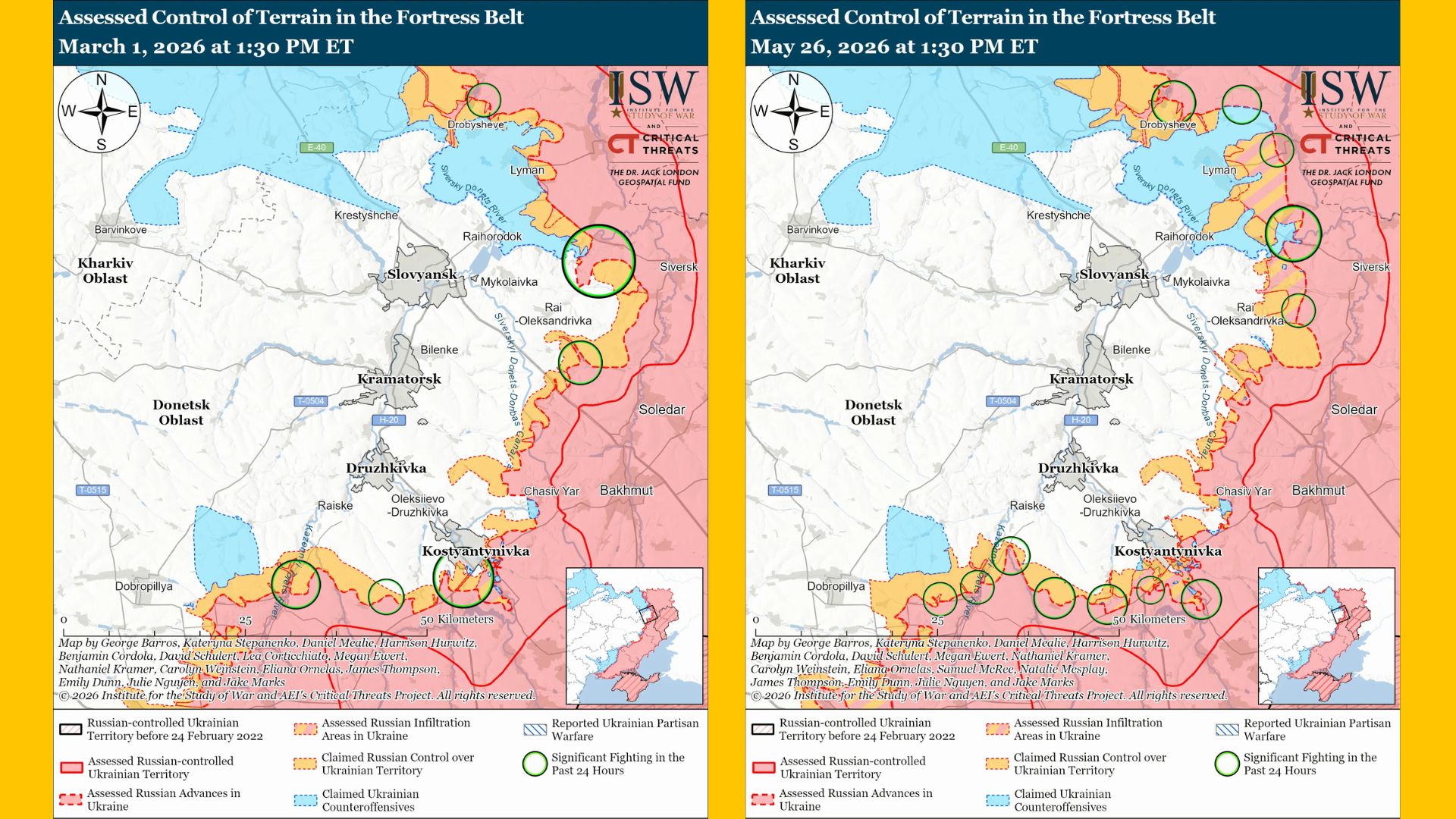
The maps below (Institute for the Study of War: assessed control of terrain as of March 1, 2026 and May 26, 2026) showhow limited the changes on the frontline around the Fortress Belt actually are,
despite months of assaults and heavy personnel losses.
According to the figures revealed in the Commander-in-Chief of the AFU report at NATO headquarters in Brussels, as of May 20, 2026, the Russian daily casualties are at least 1,000 soldiers each day, killed and wounded. Since the beginning of 2026, the total enemy losses have exceeded 141,500, of which over 83,000 are non-recoverable.
According to the Kyiv Independent, Defence Minister Mykhailo Fedorov said at a closed-door press briefing on May 16 that Russia lost 67 soldiers per square kilometre of advance in October, though the number increased to 165 in January, 244 in February, 254 in March and 179 in April.
A general report submitted to the United States Congress stated that Ukraine retook 400 square kilometres of territory in a limited counter-offensive
, the first net territorial gains since 2023, after disrupting one of the hidden technological foundations of Russian operations - access to grey-market Starlink terminals.
Also, Ukrainian forces intensified strikes against Russian oil infrastructure, logistics hubs and military facilities deep inside Russian territory. These strikes undermined the long-standing Kremlin narrative that the war remained distant from everyday life inside Russia. In our recent analysis, we examined how Ukraine's expanding long-range strike campaign is extending the war deeper into Russian territory and targeting the infrastructure sustaining Moscow's war effort.
When the plan of territorial breakthroughs failed, the Kremlin increasingly frames attacks on Ukrainian cities as a form of retaliation and proof of continued strength. The strike on Kyiv on May 24, 2026, with 90 missiles and around 600 drones, became an example of this approach, also as Russian authorities claimed just days after it that it was only the beginning of a plan to destroy Kyiv.
Promised to be focused on military targets, the strike on Saturday night damaged civilian infrastructure: water supply systems, residential areas, schools, markets and cultural sites, among them the National Art Museum and the National Chornobyl Museum.
In narratives aimed at internal Russian audiences, such strikes are framed as retaliation. In practice, however, they also help the Kremlin shift attention away from limited battlefield results. Despite all the Kremlin's promises, triumphant rhetoric and heavy personnel losses, the story of spring 2026 is not about a Russian breakthrough.
Instead, the spring of 2026 became a story of how Ukraine prevented it and changed the economics of the battlefield in the process.
This publication was compiled with the support of the International Renaissance Foundation. It's content is the exclusive responsibility of the authors and does not necessarily reflect the views of the International Renaissance Foundation.


